Optical Modulators Based on Phase Change Materials
相変化材料に基づく光変調器
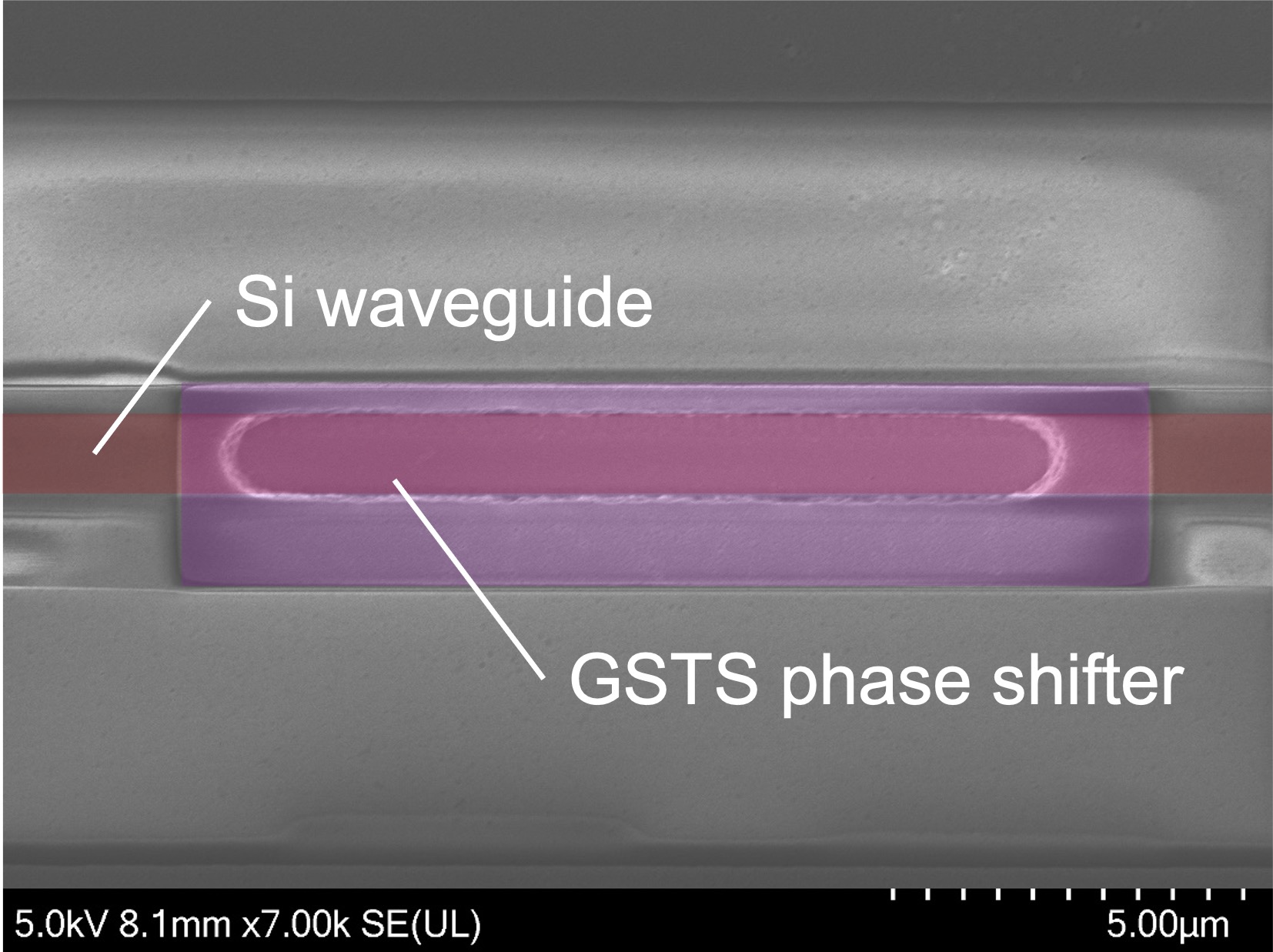
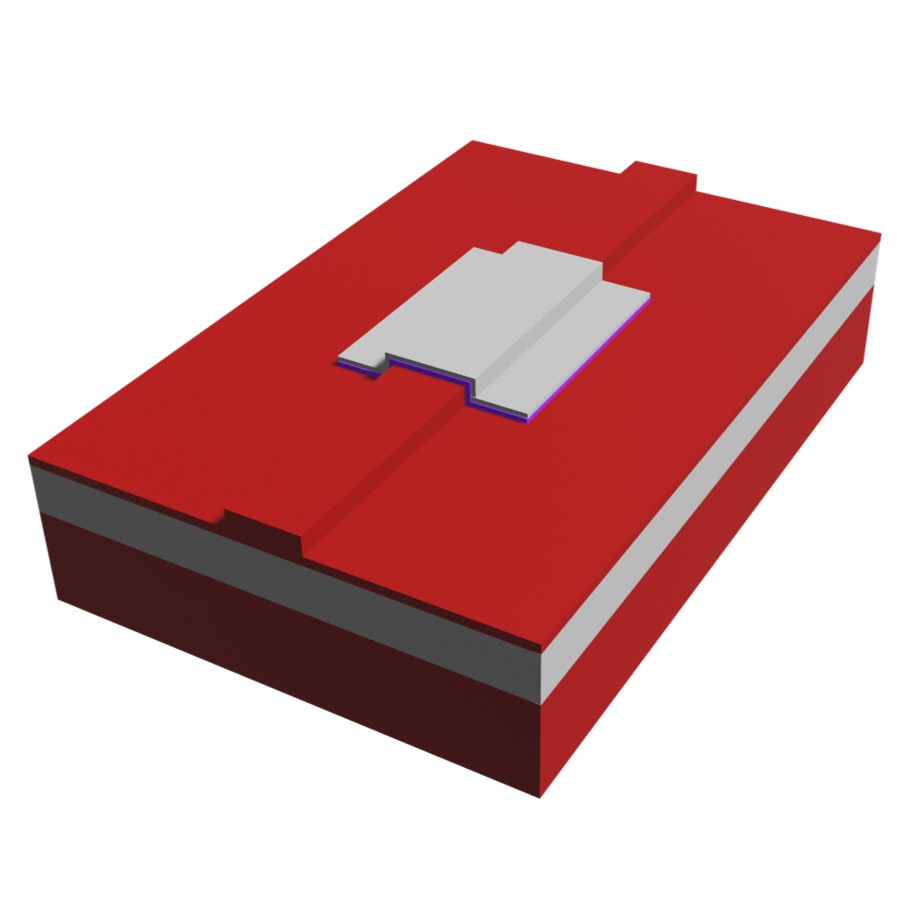
Phase Change Materials (PCM) exhibit non-volatile phase transitions between crystalline and amorphous states, accompanied by significant changes in physical properties. Traditionally, they have been utilized as storage media for rewritable CDs, DVDs, and phase-change memory. I am researching compact, high-performance optical modulators in silicon photonics by leveraging the exceptionally large and non-volatile refractive index changes of PCMs in the near-infrared region. To achieve miniaturization and low loss in PCM-based optical phase and intensity modulators, I have demonstrated phase modulators using GST (Ge2Sb2Te5) operating in the mid-infrared region (wavelengths above 2 μm) (Miyatake et al., 2022). Furthermore, I have demonstrated optical phase and intensity modulators using GSTS (Ge2SbTe3S2), a novel material with extremely low optical absorption compared with GST (Miyatake et al., 2023; Miyatake et al., 2024). I am also exploring optical computing applications, such as optical matrix multiplication circuits, utilizing these modulators.
Yuto Miyatake received the 49th Yasujirou Niwa Memorial Paper Award for this paper. This award is presented to young researchers who have conducted original research and published outstanding papers in the fields related to electronic and communication engineering (broadly including information engineering, electrical engineering, and related areas). It was established in 1977 in honor of Dr. Yasujirō Niwa, the first president of Tokyo Denki University, to commemorate his achievements.
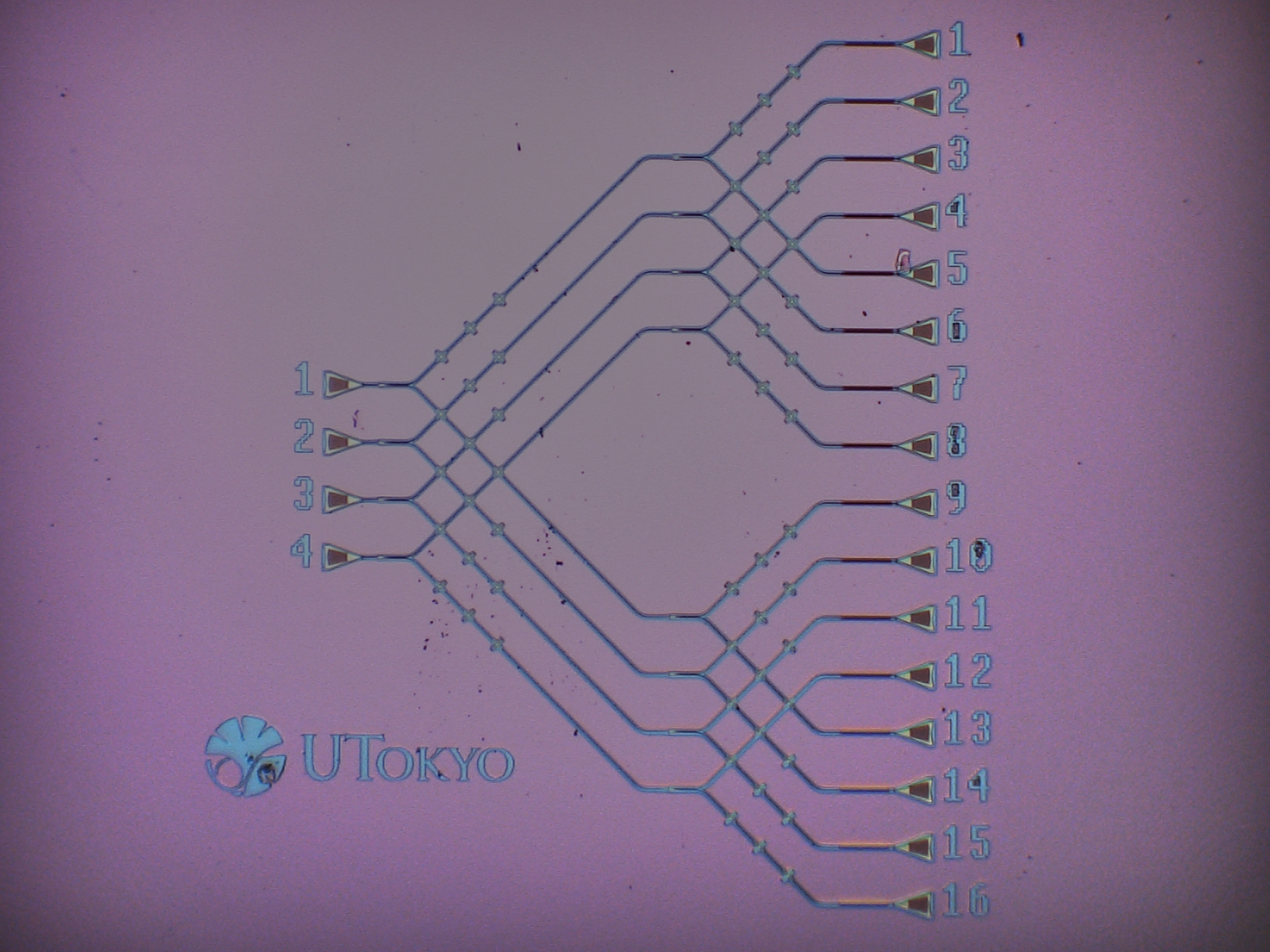
We propose a low-insertion-loss (IL) and non-volatile optical intensity modulator based on Ge2Sb2Te3S2 (GSTS), a recently proposed Se-free wide-gap phase change material. Owing to the negligibly small optical absorption of amorphous GSTS at a wavelength of 1550 nm, a non-volatile intensity modulator with a low IL of less than 0.08 dB and a high extinction ratio (ER) of 19.6 dB is realized using GSTS with a device length of 8 μm, overcoming the trade-off relationship between IL and ER in conventional Ge2Sb2Te5 (GST). Using visible laser light irradiation, we demonstrate multilevel modulation up to 24 levels by taking advantage of the small optical absorption of amorphous GSTS and the moderately large optical absorption of crystalline GSTS compared with GST. With the proposed GSTS intensity modulators, we demonstrate 4×4 matrix-vector multiplication using a recently proposed photonic tensor core, which shows a high tolerance to hardware error accumulation. On the basis of the experimental results, we numerically confirm that a high recognition accuracy of 97.33% can be obtained using a convolutional neural network with emulated optical convolutional operations.
@article{MIYATAKE_2024_JLT,author={Miyatake, Yuto and Tang, Rui and Makino, Kotaro and Tominaga, Junji and Miyata, Noriyuki and Okano, Makoto and Toprasertpong, Kasidit and Takagi, Shinichi and Takenaka, Mitsuru},journal={Journal of Lightwave Technology},title={Photonic Matrix-Vector Multiplication With Low-Insertion-Loss and Non-Volatile Ge<sub>2</sub>Sb<sub>2</sub>Te<sub>3</sub>S<sub>2</sub> Intensity Modulators},year={2024},volume={42},number={12},pages={4347-4354},keywords={Modulation;Optical modulation;Photonics;Tensors;Pulse modulation;Adaptive optics;Transmission line matrix methods;Non-volatile intensity modulator;phase change materials;photonic matrix multiplication;photonic tensor core},doi={10.1109/JLT.2024.3408877},issn={1558-2213},month=jun,}
An optical phase shifter based on phase-change materials (PCMs) is a promising building block of quantum photonic integrated circuits (QPICs) operating at mid-infrared (MIR) wavelengths on a Si photonics platform. In this article, we propose a record low-loss non-volatile PCM phase shifter operating at MIR wavelengths based on Ge2Sb2Te3S2 (GSTS), which is a new Se-free widegap PCM. On the basis of the refractive index and extinction coefficient spectra measured by spectroscopic ellipsometry, we show that GSTS has excellent material properties for optical phase shifters. By using GSTS in the MIR range, the optical absorption of a PCM phase shifter can be considerably reduced. We achieved an optical loss of 0.29 dB for a \pi phase shift, which is the lowest loss ever reported for a PCM phase shifter integrated with a Si waveguide. We also demonstrate the non-volatile resonance wavelength tuning of a microring resonator (MRR) with a GSTS phase shifter and the optically induced phase transition of a GSTS phase shifter based on laser irradiation.
@article{MIYATAKE_2023_TED,author={Miyatake, Yuto and Makino, Kotaro and Tominaga, Junji and Miyata, Noriyuki and Nakano, Takashi and Okano, Makoto and Toprasertpong, Kasidit and Takagi, Shinichi and Takenaka, Mitsuru},journal={IEEE Transactions on Electron Devices},title={Proposal of Low-Loss Non-Volatile Mid-Infrared Optical Phase Shifter Based on Ge<sub>2</sub>Sb<sub>2</sub>Te<sub>3</sub>S<sub>2</sub>},year={2023},volume={70},number={4},pages={2106-2112},keywords={Phase shifters;Phase change materials;Optical variables control;Optical refraction;Optical losses;Silicon;Photonic band gap;Mid-infrared (MIR);non-volatile;phase-change material (PCM);phase shifter},doi={10.1109/TED.2023.3235865},issn={1557-9646},month=apr,}
We investigate an optical phase shifter based on Ge2Sb2Te5 (GST) integrated with a Si waveguide at mid-infrared (MIR) wavelengths. Since the optical absorption of both amorphous and crystalline GST can be reduced at a longer wavelength, we demonstrate that the optical loss of the phase shifter can be reduced at MIR wavelengths. The measured optical loss per π phase shift of a phase-change material (PCM) phase shifter at 2.32 µm wavelength is 2.6 dB/π, which is more than 80 times smaller than that at 1.55 µm wavelength (21.7 dB/π) and more than 5 times smaller than that at 1.92 µm wavelength (9.7 dB/π). Moreover, resonance wavelength tuning of an add-drop micro-ring resonator using a PCM phase shifter at 2.32 µm wavelength is demonstrated owing to the low-loss optical phase shift. These findings reinforce the applicability of the approach toward a low-loss optical phase shifter based on PCMs operating at MIR wavelengths on a Si photonic platform for quantum computing, sensing, and optical communication.
@article{MIYATAKE_2022_OME,author={Miyatake, Yuto and Ho, Chong Pei and Pitchappa, Prakash and Singh, Ranjan and Makino, Kotaro and Tominaga, Junji and Miyata, Noriyuki and Nakano, Takashi and Toprasertpong, Kasidit and Takagi, Shinichi and Takenaka, Mitsuru},journal={Opt. Mater. Express},keywords={Lidar; Material properties; Optical absorption; Phase shift; Photonic quantum computing; Rayleigh scattering},number={12},pages={4582--4593},publisher={Optica Publishing Group},title={Non-volatile compact optical phase shifter based on Ge<sub>2</sub>Sb<sub>2</sub>Te<sub>5</sub> operating at 2.3 \&\#x00B5;m},volume={12},month=dec,year={2022},url={https://opg.optica.org/ome/abstract.cfm?URI=ome-12-12-4582},doi={10.1364/OME.473987},}